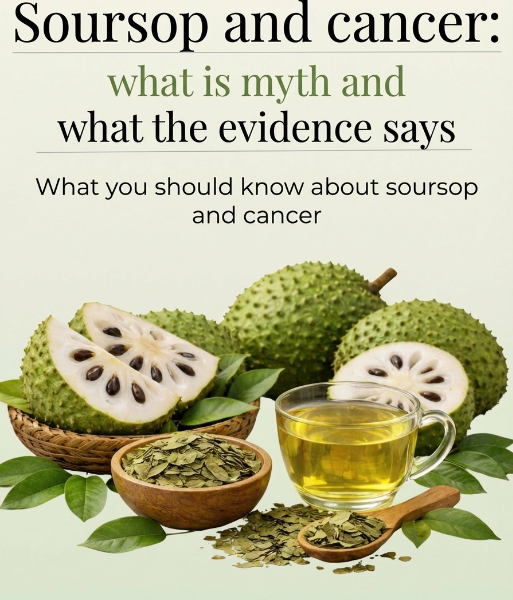

Across the internet, thousands of posts claim that soursop (Annona muricata) can “cure cancer.” This idea has spread widely, leading many people to accept it as fact. However, the reality is far more complex. If you’re seeking reliable information about soursop and cancer, this article explains what research shows, what hasn’t been proven in humans, and the risks of believing absolute promises.
Important note: This content is informational and does not replace medical advice. Any changes to cancer treatment should be discussed with an oncologist.
.png)
What Is Soursop and Why Is It Linked to Cancer?
Soursop, also known as graviola or guanábana, is a tropical fruit widely consumed as food. In some cultures, leaves and stems are used for traditional infusions.
Interest in cancer comes from plant compounds such as acetogenins, which show biological activity against certain cells in laboratory studies. The issue arises when preliminary scientific interest is misinterpreted as a “proven cure,” which currently lacks solid clinical evidence in humans.
Understanding the Types of Studies
To avoid confusion, it’s important to distinguish between different levels of research evidence:
- In vitro (laboratory studies): Tested on cells, not people.
- Animal studies: Useful for exploring mechanisms but do not confirm human efficacy.
- Clinical trials in humans: Only these studies can determine whether a treatment works, at what dose, for whom, and with what risks.
Most popular claims about soursop and cancer rely primarily on lab studies, not on conclusive human trials.
Common Myths About Soursop and Cancer
Myth 1: “Soursop cures cancer”
There is currently no reliable evidence that soursop treats or cures cancer in humans.
Myth 2: “It’s more effective than chemotherapy”
Chemotherapy and other cancer therapies are backed by decades of clinical research. Soursop has not been tested at this level in humans and cannot replace medical treatments.
Myth 3: “Soursop leaf tea eliminates tumors”
No robust clinical evidence supports that a leaf infusion can remove tumors. Lab results do not directly translate to effects in the human body due to metabolism, absorption, dose, and safety factors.
Myth 4: “Being natural means it’s safe”
Natural does not mean harmless. Compounds like annonacin in soursop may pose neurological risks if consumed frequently or in concentrated forms.
Myth 5: “It works for all types of cancer”
Cancer is not a single disease. There are many types and subtypes, each requiring specific treatments. Claims of universal effectiveness are a red flag.
Important Truths About Soursop and Cancer
Truth 1: Lab activity does not equal human efficacy
While laboratory and experimental models show anticancer activity, this does not confirm therapeutic effects in humans. High-quality reviews highlight methodological limitations and recommend caution.
Truth 2: As a fruit, soursop can be part of a diet
Eating the fruit as part of a balanced diet is generally safe. The focus is nutritional, not anticancer.
Truth 3: Supplements are not substitutes for treatment
If someone wants to use traditional remedies for well-being (hydration, appetite, routine), it should be discussed with their medical team, and proven treatments should not be abandoned.
Risks and Precautions
One frequently overlooked issue is safety. Research suggests a potential link between high consumption of Annonaceae products (including soursop infusions) and atypical parkinsonism in certain populations, as well as experimental evidence of neurotoxicity from compounds like annonacin.
Avoid:
- Concentrated capsules or extracts of uncertain origin.
- Daily protocols lasting months without supervision.
- Mixing supplements with medical treatments without informing an oncologist.
Can You Drink Soursop Leaf Tea?
If using it as a traditional practice (not treatment), moderation and caution are key.
Traditional infusion (occasional use):
- 3–5 clean soursop leaves
- 2 cups of water
- Boil water, add leaves, simmer 10 minutes, let rest, strain
Guideline:
- ½ to 1 cup, 2–3 times per week (not daily)
- Do not use for long periods without supervision
Avoid without medical advice if:
- Undergoing cancer treatment (chemo, radiotherapy, targeted therapy, immunotherapy)
- Have low blood pressure or neurological conditions
- Taking regular medication or anticoagulants
- Pregnant or breastfeeding
The key is not prohibition but avoiding uncontrolled, prolonged use, especially alongside proven medical therapies.
How to Discuss Soursop with Your Doctor
Many people avoid mentioning it out of fear. Here are practical ways to start the conversation:
- “I’ve read information about soursop and cancer. Is it safe for me?”
- “Could it interact with my medications?”
- “Would you recommend limiting it to the fruit only?”
This approach helps your medical team guide your choices safely.
Conclusion
Soursop is not a cure for cancer according to current clinical evidence, but it contains compounds of scientific interest, mainly in laboratory studies. The real danger is misinformation: promising cures, selling “miracle” extracts, or encouraging patients to abandon proven treatments.
If you want to include natural products in your routine, do it responsibly: eat a balanced diet, follow your doctor’s guidance, and use leaves/extracts with caution. This protects your health and avoids false expectations.